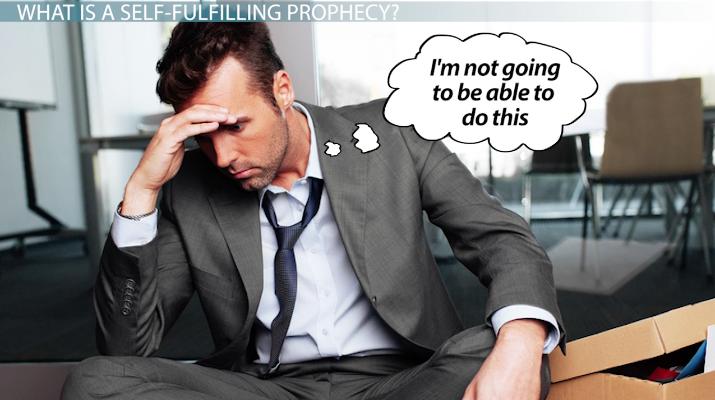
“A self-fulfilling prophecy is a sociological term used to describe a prediction that causes itself to become true.” – Simple Psychology.
It was 1987, and I was crying in my Academic Advisor, Professor William Dorman’s office. I had just told my mentor that I was going to drop out of California State University, Sacramento (CSUS) for the second time in two years, and he was having none of it. I don’t remember exactly what he said, but my tears were not coming from my failure, but his insistence on not giving up on me. For the second time, he came up with a plan for me to take an incomplete, do my best to complete my other courses, and come back next semester and finish the class. I did just that and received an A- on my term paper. (He gave it an A, lined it out, and wrote A- with a note about it was late by a semester.)
Professor Dorman left me with something that has stayed with me for what I imagine will be the rest of my life: I was living a self-fulfilling prophecy. Then he explained exactly what that was. It was not a compliment. Still, it was the first time I was confronted with this problem. Strange that I have never been able to shake it. It’s been 39 years since my mentor told me that I was living a self-fulfilling prophecy. He wasn’t dooming me, he was telling me this hard truth so I could shake it, work my way through it, but even today I see this in the mirror after I have fucked up something, even in little things like playing a game of chess or trying to solve a chess problem, and falling on my face. I wrote about it in a recent post.
Relatively speaking, things came much more easily to my father, brother, and my brother’s best friend. And to my friend Jesse, well, he was a Golden Boy: things didn’t just come easy to him; he was instantly proficient in things like sports–something I struggled with back when being at least okay would have been a boost for my ego. I was the kid who warmed the bench in Little League and was picked last in recess games. Even something like driving a car, I was inept: I needed four tries until I passed my driver’s test at DMV. Nothing ever came easy, and it only drove home the idea that I was some kind of reject.
If only I had had someone like Tony Robbins as a best friend growing up, who made me his project and, along the way, kept correcting my self-criticism with positive affirmations. When I attended American River College (ARC), I had my friend Rick. He was the closest thing to my own Tony Robbins, often trying to inject me with confidence, usually sticking with my writing (he was the editor-in-chief at ARC’s newspaper, and I was a reporter) and girls. He was both fascinated and frustrated that I was still a virgin at 21. He even took some of the female newspaper staffers aside and asked whether they would go out with me if I asked. Rick and I would take other classes together, and during boring lectures, he would tell me he knew that if I asked Ann, Susan, and other girls whose names I have forgotten, they would say yes.
Rick assumed this would somehow fix my self-esteem, at least when it came to the opposite sex, but it only created a kind of paralysis when being around these girls, especially when I was working on the same galley with one of them. Galleys, for the uninitiated, were narrow, which meant if two people were working on one together, it was a tight fit; any accidental bump felt magnified, leaving me flushed with embarrassment and second-guessing every word I wanted to say. The pressure of proximity heightened my self-awareness, compelling me to retreat into silence rather than engage. The paralysis was so bad that I recall lying in bed and fantasizing that Ann, Susan, or whoever would reach out and kiss me while working on the same galley. Not a healthy pastime. Rick’s tutelage didn’t last long; within a year, he moved to Southern California, and with him, the closest thing I had to a personal Tony Robbins.
While I was a complete washout in the dating department, at least Rick turned me onto writing, music criticism, film criticism, Greil Marcus, and Rolling Stone Magazine. He basically helped create a somewhat passable writer and a raging music and film critic, some would say even a snob. Think of a cross between the three guys in the used record store in High Fidelity. See below for a sample:
Not that I had a history of girlfriends like Rob (John Cusak, on the left), nor was I an over-the-top, in-your-face snob like Barry (Jack Black, on the right). I was more like Dick (Todd Louiso in the middle), but with a dash of the other two characters. (If you haven’t figured it out yet, I have an obsession with the book and film High Fidelity.) Being a music and film critic didn’t get me anywhere with the ladies, and, strangely enough, it didn’t dispel the shadow of a self-fulfilling prophecy that haunted me. Funny, if anyone had questioned my opinion on cinema or music, that person would never have known I had such low self-esteem—that I was an asshole, maybe. Still, I had self-confidence in spades when it came to film and music.
It seemed like this self-fulfilling prophecy was impossible to shake, so I shouldn’t have been surprised when working for the Tower Theatre, and later, when I got my first job with the State of California, there were two women with overcharged libidos who pursued and seduced every male on the respective staffs–except me. Sharon (a Tower staffer) and Shelley (a State worker) must have felt that break times were times to hunt the floor for some guy, any guy (except me, it turned out), find a closet or an unoccupied office, and sucked faces with these gents. I guess it was a blessing in disguise that I was singled out as the exception to these two nymphets’ horniness. Still, I couldn’t help but feel, once again, that I lacked something: sufficient levels of testosterone, pheromones, oxytocin, dopamine, or whatever attracts the opposite sex. Who knows. SoCal Rick, whom I had kept in correspondence with, wrote about both occasions, saying I probably telegraphed to these horny women an insufficient level of self-confidence to have either Sharon or Shelley pull me by my tie into the popcorn room or print room and stick their tongues down my throat. I spoke to most of the women those days in a fatalistic tone, knowing that if I asked them out, they would all say no.
Even the women I ended up dating basically had to pursue me. First, there was Mary, quite possibly the most beautiful woman I have ever seen in person. She worked at the Tower Theatre when I was the crew chief of the floor staff. We enjoyed talking about music and film, but I never thought she would go out with me (or anyone else I ever met — she was that stunning), so I kept it to The Clash, Bob Dylan, the films of Ingmar Bergman, and which candy she needed to restock the concession stand.
When she had given her one-week notice that she was moving back to Texas, I felt liberated–like I could now talk to her about more intimate things, like whether she thought Erin would go out with me if I asked. (I wasn’t planning, by the way. That was way too scary.) She sounded a little annoyed by the question, answering, “I don’t know!” then followed up with the jaw-dropping, “I don’t know why you haven’t asked me out in all this time.”
We went on three dates during her last five days in Sacramento. During those dates, I still would rarely talk about anything outside of music, film, and work, even though it was awkward as hell. Also, just walking down the street with her was intimidating. Men, much more attractive than I, would turn their heads; younger ones would whistle and make lewd comments at her. She ignored them. It was an eye-opening experience: this is the shit that a lot of women have to endure.
She was gracious about my complete clumsiness towards dating, and one time, when we worked together the day after a date, she left a long-stem red rose in the ice machine–the first place I would go when I was prepping the concession stand before opening. While this was touching, I remember that after the event, after she had moved back to Texas, the dichotomy between us — at least in the dating scene — was clear: she was gorgeous and sensitive in the ways of courting. I was, well, I was me. Looking back on my very short time with Mary, I wish she had been the one who shattered my self-esteem problem, and maybe it would also affect all the other shit I was horrible at, but this problem was so deeply ingrained that even the fact that Mary liked me didn’t seem to make a dent.
Shortly after Mary left for Texas, Judi, another Tower employee, pursued me. Once again, I didn’t have to work on what turned out to be a very unhealthy relationship. I wrote a PG-rated version of it in the post The Ballad of the Codependent Rat. The day after I finally got up the courage to break up with Judi, my future wife called to ask if I wanted to come over for a beer. I’ll leave my wife of 38 years out of this, since it kind of runs counter to the whole self-fulfilling prophecy, and my wife doesn’t like me writing about her on the blog–I don’t even mention her first name in this blog to make doubly sure she is left out of my drama.
Interestingly, I used to have a crush on Michelle, another person who worked on the Tower floor staff. (Yes, folks, it was a regular soap opera at that place in the early and mid-1980s.) Anyway, Michelle once told me, in a big sisterly way, one night, probably after having to watch me degrade myself so effortlessly, “Jack, how can you expect someone to love you when you don’t love yourself?” Somehow, my wife defied what sounds like a perfectly logical statement. I finally got lucky, I guess, but it didn’t help me in all the other aspects of my life.
This post wasn’t supposed to be solely about my horrible batting average when it came to dating. There are many instances where I realize I’m living a self-fulfilling prophecy. All my college years, where my graduating GPA was barely a 2.0, and that’s after I rallied in my last two years. There’s my short-lived stint in Little League, where I played half of each game, and when I did play, it was in Right Field, which might as well have been a desert as far as seeing a baseball, and when they introduced the batting tee, I actually struck out. I wonder if there is a Guines Book of World Records for striking out when the ball isn’t even moving. Or in golf, where my nickname was “Shank.” I also am haunted by this prophecy when it comes to practicing yoga, trying to play chess, riding my bicycle, and other bagatelles too numerous and depressing to mention here. So that’s my TED Talk on My Self-fulfilling Prophecy, folks. Thanks for reading.
If I didn’t define a self-fulfilling prophecy well enough above, here’s my current favorite stand-up comedian explaining it.


Leave a Reply