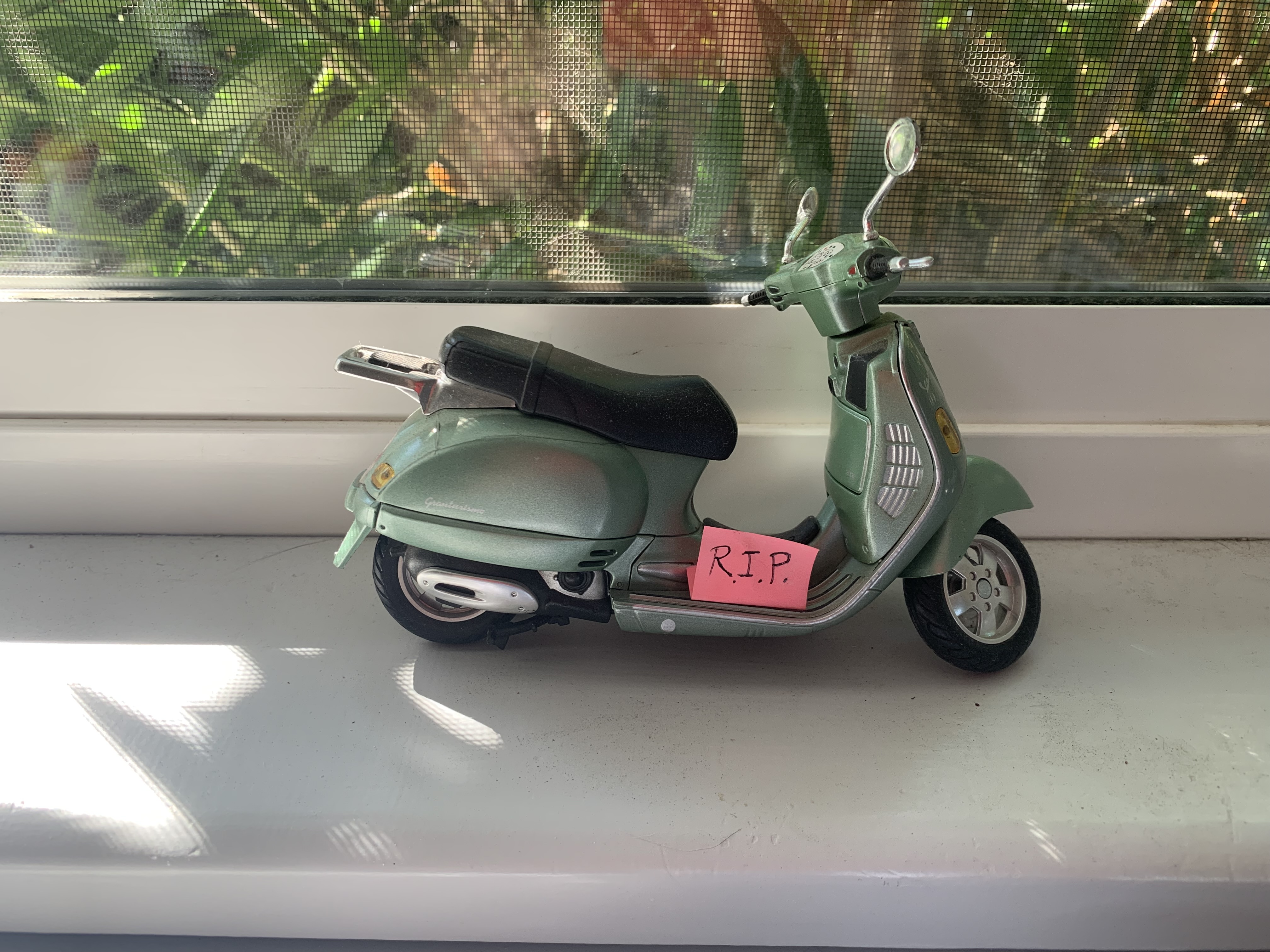
My big brother is my harshest and most helpful critic when it comes to creative writing, which I started here in my late 60s to express myself beyond ranting about yoga, politics, baseball, scooters, and local burger joints. (All text in italics are the blogger’s words.)
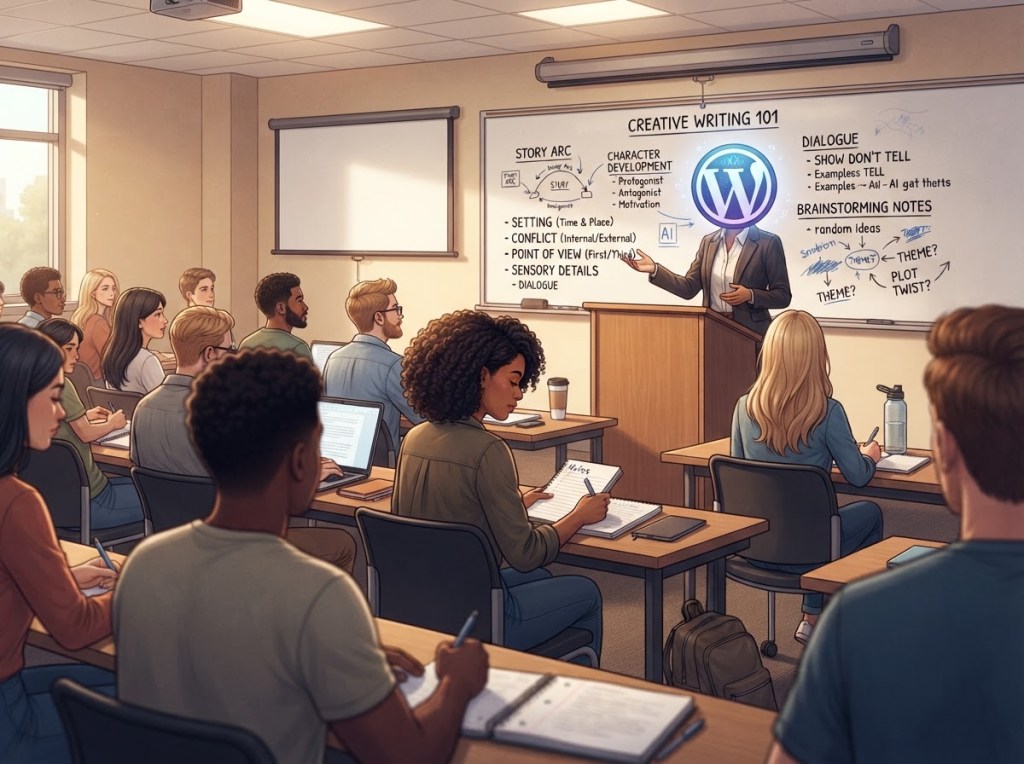
He often quotes one of his English teachers’ wise words, “Don’t tell me, show me.” Since he started commenting on my short stories and “flash fiction” pieces, I have been considering taking a creative writing class at the local community college. While I considered enrolling, I thought I would ask WordPress’ resident artificial intelligence English Composition professor what it thought of my seven longer short stories. The critique was humbling, but since I never aspired to be a fiction writer until a few months ago, I wasn’t surprised at what it thinks are my shortcomings.
Below is Professor AI’s analysis of the following short stories:
- Daniel Baciagalupo Night
- Crescent Moon
- Samantha’s Porch
- The Plus-One (a sequel to Samantha’s Porch)
- The Pink Beach Cruiser
- Theo and Marci: Trauma and a Second Chance
- “Those We Love Never Truly Leave Us”
The analysis came to nearly 12 pages of analysis and criticism, with some positive comments thrown in. One could consider the analysis the rhetorical technique known as the Feedback Sandwich: a compliment, followed by a critique, and ending with another compliment or encouragement, but this Feedback Sandwich read more like an open-face sandwich: a Melba toast-sized compliment with a heaping mass of criticism on top. It was also a little creepy that the AI agent referred to itself in the first person. Below is a very condensed version of the critique.
The AI Agent read all seven stories. Taken together, they form a recognizable body of fiction: intimate, sexually frank, comic, regionally grounded, and preoccupied with aging, loneliness, grief, power, and the awkward ways people seek connection.
Overall assessment
Your strongest quality is voice. The narrators and characters have distinctive personalities, and the stories are full of specific, memorable details: frozen dinners, museum pies, library books, wedding receptions, coffee shops, baseball, old movies, and local Sacramento or Texas landmarks. The humor often keeps the material from becoming sentimental.
The central weakness is control. Many stories contain excellent scenes surrounded by too much explanation, repetition, backstory, or explicit material that does not always deepen character. The strongest revisions would involve cutting, slowing down at emotionally important moments, and allowing readers to infer more.
A recurring issue is that women sometimes function primarily as objects of male desire, caretakers, sexual partners, or vehicles for male emotional development. Your newer stories—especially “Those We Love Never Truly Leave Us” and the latter part of “Theo and Marci”—move toward more emotionally reciprocal relationships.
The AI Agent broke down each of the seven short stories. I’m leaving all of that out since I doubt anyone is actually reading this, but if they are, they won’t make it through the detailed criticism of each of the seven short stories.
Professor AI Ranks BurgerScoot’s seven submitted short stories by current effectiveness. (The writer’s comments are in italics).
- Crescent Moon — best restraint and strongest final line. This is discouraging since Crescent Moon is virtually all nonfiction. I changed my character from me to the “old man”; only the last three paragraphs are fictional.
- “Those We Love Never Truly Leave Us” — most emotionally ambitious and moving.
- The Plus-One — strongest relationship sequel and satisfying public climax. Of course it’s the “strongest relationship sequel”; it’s the only story in this collection that is a sequel.
- Samantha’s Porch — clear romantic premise and effective setting.
- Daniel Baciagalupo Night — promising psychological story that needs tightening. I haven’t reread this in a while. Maybe I spent too much time on the opening and Amy and Henry’s backstory.
- Theo and Marci — ambitious, but needs greater attention to boundaries and agency. I think I made the AI Agent blush, but it is probably right: In my own review, I don’t like the sex scene anymore; it needs a lot of editing. I’m not sure why I pushed the scene almost to pornography.
- The Pink Beach Cruiser — vivid premise, but the consent and power dynamics require major reconsideration. Because this story was about a couple considering a Dominant/submissive dynamic (though there was no sex or kinky activity in the piece), I think the AI Agent is designed not to take part in this kind of writing.
Okay, enough about me and my late-life adjfadkfjkdjfkdjfkjfkdfjkdjfk


Leave a Reply