

In my practice, this question has been raised occasionally, mostly in books I have read: Are yoga mats essential? Below is a combination of the old question and new information with a possible answer for me.
When I became interested in yoga nearly twenty years ago, I recall attempting and ultimately failing to create and stick to a home practice (there were too many distractions). The few Yin Yoga sessions I did were either on a carpet or a rug. I hadn’t bought a mat yet and realized, at least at that time, I didn’t need one.
Standing on a mat, getting ready for the dreaded first of three balance postures (I knew my old teacher’s routine by heart). The first balance posture was always Tree. It was and still is impossible to stick the pose without the easiest modification. (I have been on antiseizure meds since I was twelve, and one of the unfortunate side effects of the drug is poor balance.) While I tested the waters each time and tried to do the pose on one foot, I would need the toes and ball of that other foot on the ground, acting like a kickstand to execute the baby version of the posture successfully. First things first–I get off the mat! Now that’s stable–no smushing feeling under my foot-and-a-half.
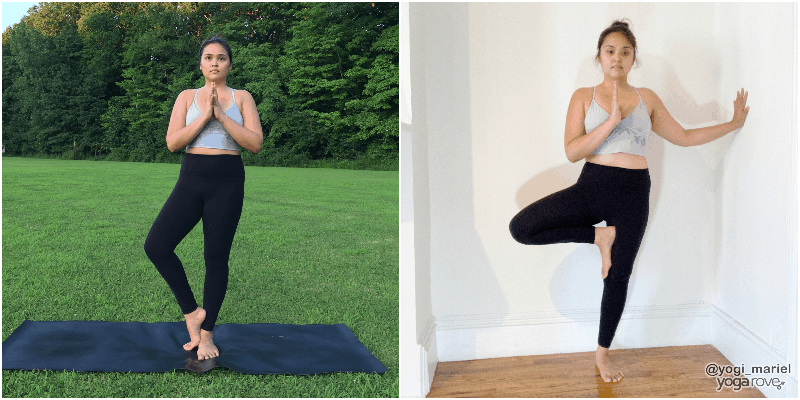
When moving from a forward fold posture to a Downward Facing Dog, my hands slip. So, I do need a mat. But did the yoga masters of the past use a mat? Did they always practice on a surface where they wouldn’t slip and break their nose? No, since the yoga mat is an American invention.
In the late Mukunda Stiles’ excellent Structural Yoga Therapy, I was first introduced to the ideal yoga practice setting, including the idea that a yoga mat is not necessarily needed for at least all standing postures:
“Ideally, yoga is practiced in the same place and time each day. The space should be well ventilated, so that air circulates freely. It should have natural light and also be about to be completely darkened for relaxation. There should be a carpet or mat large enough to stretch out on fully. If a padded mat is used, it should be used only for floor exercises. Standing poses are best done on bare wooden floors or thin, “sticky mat.”
Stiles didn’t rail against the yoga mat, but was open to using other surfaces.
In a Yoga International article, Colin Hall reveals that the yoga mat is a recent invention, considering that the practice is over 5000 years old. It was developed by the father of Angela Farmer, one of the most influential yogis of the last half-century, who, due to surgery, couldn’t sweat from her feet and hands. Farmer’s father made the mat from German carpet underlay. The original yoga mat–an invention of necessity for a man’s daughter–is now the most omnipresent item in the world of yoga and is immediately recognizable in the world of sports, much like the soccer ball.
Note: Farmer’s Wikipedia entry tells a slightly different story. Farmer made the first mat in 1967. Farmer’s father took the prototype and contacted padding manufacturing to mass-produce the mats, and the rest is history. The modern yoga mat was born and took off with the practice, especially in America.
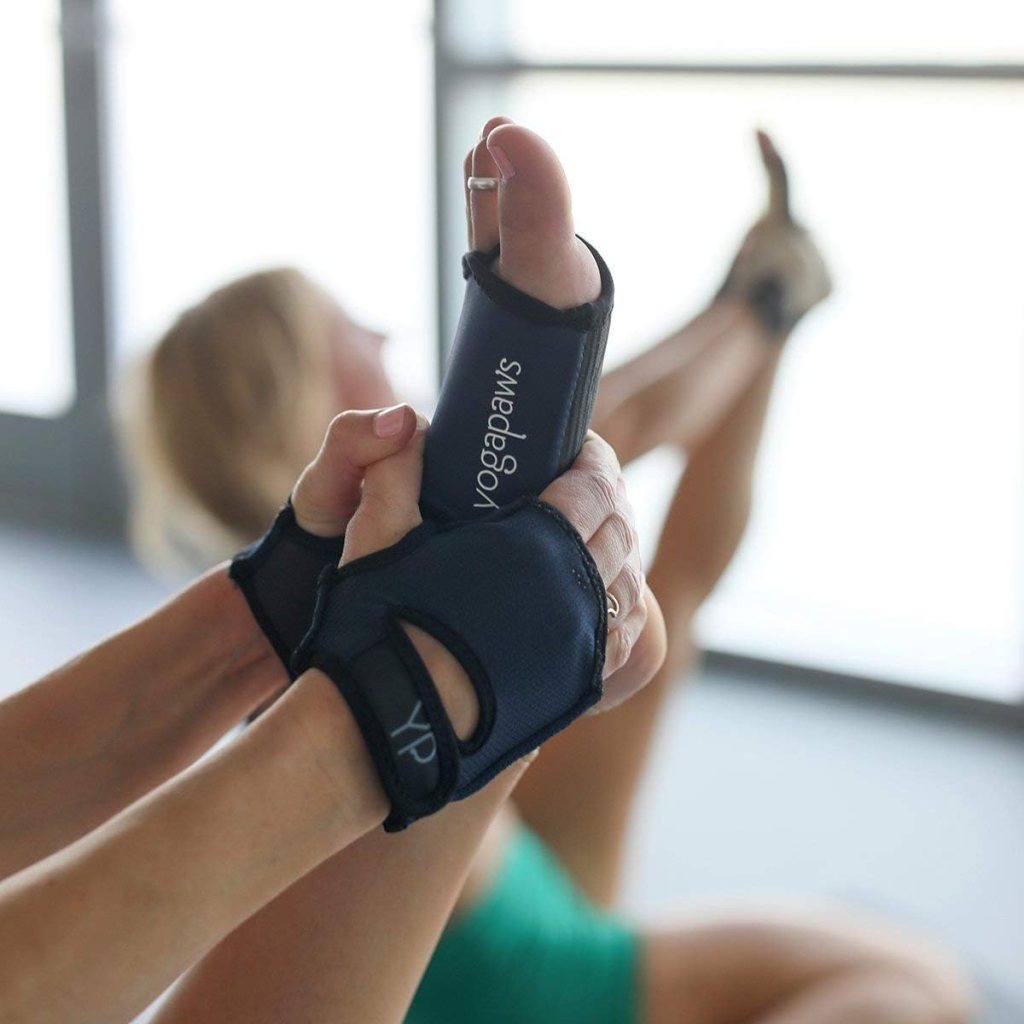
Studio owners and some teachers have stressed that their clients/students use a mat, except for some who allow no mat, but grip socks and gloves. At least one studio owner told me it has to do with insurance. I have a pair of cheap Gaiam socks that I have never worn while practicing. I think the answer to the question in this post’s title is: it depends; a home routine could be easily done on a rug or a carpet in a living room, but unless you are wearing proper hand and footwear, your local studio owner may call you out.
In my inconsistent yoga journey (broken up by stints gym rat days on a rowing machine, doing burst circuits, and later TRX, then back to the mat, then trying Pilates on a Reformer LINK, then returning to the mat, then to have the club where I practiced club close due to Covid. I returned to the mat again only to get injured and recuperate from a traffic accident LINK. I have practiced yoga on many mats. Most of them belonged to a health club that provided the mats and toys (blocks, straps, bolsters, etc.), but other times I needed to provide my own mat; I have cycled through at least four mats: A hastily purchased thick mat, a folding two mm-thin mat that killed my knees, an almost too short mat my wife used to exercise on, and a used mat a beloved teacher gave me.

All of these mats would be slippery occasionally, and I was dreading the day I broke my nose or jacked up a knee. I mitigated that problem on my penultimate mat by applying Manduka Yoga Grip LINK to my hands and feet before each practice. The gel created a moisture barrier between my skin and my mat. But it made a mess of my hands, feet, and mat, and I found myself the last student out of the studio with people waiting for me to exit. Finally, I broke down and bought a 4mm eKO® Lite Yoga Mat, which is sticky, so I don’t need the gripping agent anymore. It is also thick enough for this older man’s knees, but not so dense that I feel my feet sinking into the mat while standing on it. Also, the mat, when rolled up, fits in my bag.
Still, whenever there is an empty spot to my left or right in the studio, I use the naked floor for standing postures. Nothing beats the hard pine when it comes to executing most standing postures.
Speaking of mats:
Here’s a humorous yoga mat story I posted back in 2015. Author unknown: Yoga mat for sale ad on Craigslist.

 BURGER SCOOT
Leave a comment