It’s 2025 and it’s time to review the books I read last year. This post just like the 2019 post I finished and actually published five years ago was supposed to be the first in a tradition, but. the 2020, 2021, 2022, and 2023 “Best Books I Read” never got published because I always got busy doing other things. I would hope that if I didn’t have a computer. (Sounds silly not having a computer, right? Read my entry for Wendell Berry’s excellent “The World-Ending Fire” below.)
I would at least have a handwritten “book diary” where I would log my thoughts on each book I completed. I can’t pat myself on the back this year—hard work had nothing to do with completing a “Best Books I Read in 2024.” I completed last year’s mostly due to my scooter accident and convalescing from all the broken bones the mishap delivered. So here we go in no particular order:
<<<<<<<<<<<<<<<<<<<<<<<NONFICTION>>>>>>>>>>>>>>>>>>>>>
No Name in the Street by James Baldwin, 1972
Baldwin recounts how Harlem, in his formative years Harlem shaped his early consciousness. In his adult years, he moves from New York to the liberating Paris. He tells of his time as a screenwriter in Hollywood and ultimately is return to the South. The book covers the later murders of his friends Martin Luther King Jr. and Malcolm X. As an astute observer of the two-tier system in America, none of Baldwin’s books is “easy reads,” but the best of them, like No Name in the Street
Ducks: Two Years in the Oil Sands by Kate Beaton, 2022
What a remarkable book! Kate Beaton, a graphic novelist, wrote a harrowing memoir about her two years working in the tar sands of Alberta, Canada. For a 435-page “comic book,” it packs a wallop to the gut! It reminded me of the stories I heard from people who worked on the Alaskan Pipeline in the mid-70s: stories of isolation, drug abuse, and sexual assault, all fueled by the bottom line with little or no regard for the human cost. With my vision problem I rarely “read” books anymore, but I like graphic novels. This, however, really happened and that’s what gives Ducks its power.
Bowling Alone: The Collapse and Revival of American Community by Robert D. Putnam, 2000
Check out my post on this fascinating book here.

The Demon of Unrest: A Saga of Hubris, Heartbreak, and Heroism at the Dawn of the Civil War by Erik Larson, 2024
The Demon of Unrest covers the election of Abraham Lincoln on November 6, 1860, and the events leading up to April 12, 1861, when Fort Sumner was fired upon by forces in Charleston, South Carolina beginning the Civil War. Larson’s main voices in this narrative are Major Robert Anderson, Sumter’s commander; Edmund Ruffin, a radical secessionist; and Mary Chesnut, wife of a prominent Southern planter. The book draws on diaries, secret communiques, slave ledgers, and plantation records to create a compelling true story that reads like suspense novel.
Larson knows how to pick fascinating subjects to research and write about. So far I have read Isaac’s Storm which is about Isaac Cline, Chief Meteorologist at the Galveston, Texas, who witnesses firsthand the devastating 1900 Galveston hurricane; The Devil in the White City, my introduction to Larson, which takes place at the World’s Columbian Exposition in Chicago in 1893 where a serial killer was loose; Thunderstruck: another work where Larson mixes murder with a world event, the event in this case the Marconi wireless telegraph; and In the Garden of the Beasts which is about the American Ambassador to Germany, William Dodd and his family during the 1930s when the Nazi Party became anti-Semitic and anti-Soviet and the sole legal party in Germany. There are more titles I plan to read by this master of historical nonfiction.
The Need to Be Whole: Patriotism and the History of Prejudice by Wendell Berry, 2022
Wendall Berry is a national treasure. I heard of Berry in college when a professor briefly spoke of his masterpiece in American agriculture, The Unsettling of America: Culture and Agriculture when speaking of how the corporate takeover of agriculture was running family farms out of there businesses (similar to the way Walmart Superstores runs family suburban businesses out of business and create, for lack of a better term, suburban blight years later) and slowly poisoning us, as well.
The Need to Be Whole is an excellent work on race, slavery, the Civil War, Robert E. Lee, patriotism vs nationalism, and is an “agrarian sampler,” to use his own words. The Need to Be Whole also features added essays on John Quincy Adams, John C. Calhoun, Ernest J. Gaines, and Crystal Wilkinson. I found each of these essays fascinating and–dare I say this at the risk of turning off the reader–educational. Berry is also known for fiction and his poetry.
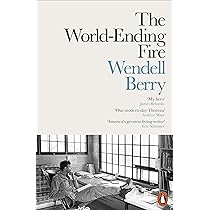
The World-Ending Fire: The Essential Wendell Berry by Wendell Berry, 2017
This is a collection of some of Wendall Berry’s more provocative essays spanning his career as a writer from 1968 to 2011. Here are only a few of Berry’s words that stuck with me long after I have finished his 1989 essay “Word and Flesh”:
“We must achieve the character and acquire the skills to live much poorer than we do. We must want less. We must do more for ourselves and each other. It is either that or continue merely to think and talk about changes that we are inviting catastrophe to make.”
I used WordPress’ tools to create the above quote in a special style and I wrote this post and all the posts in this blog using WordPress on my personal computer. You might be reading this post using a personal computer or a tablet of some kind of smartphone. Would you be surprised if I told you Berry doesn’t use any of these gadgets and he never has? Read his 1987 essay “Why I Am Not Going to Buy a computer” in this collection. In fact, Berry does not have a TV. He is on the grid; however, but that’s only for lighting and other household conveniences. He has a truck but doesn’t have a tractor. He tills his farm with a team of horses!
The World-Ending Fire has elements of his classic The Unsettling of America as he indefatigably champions family farming in the face of a massive corporate takeover. Berry calls the corporate farming for convenience, and cheaper produce, dairy, and meat as “enslavement to machines and chemicals. “As a result the our farm lands and rivers become increasingly toxic. I would call this a must-read book if you care about our environment. Just don’t expect articles on why we need more solar panels and wind farms and less coal mines and oil fields. It’s not that simple.
A History of the World in Seven Cheap Things: A Guide to Capitalism, Nature, and the Future of the Planet by Raj Patel and Jason W. Moore, 2017
I almost always write my own text about books I have read, but I have been quite ill as of late and am tire of staring at this post in draft form so I’ll let Goodreads.com describe this excellent book.
“Nature, money, work, care, food, energy… These are the seven things that have made our world and will shape its future. In making these things cheap, modern commerce has transformed, governed, and devastated Earth. In A History of the World in Seven Cheap Things, Raj Patel and Jason W. Moore present a new approach to analyzing today’s planetary emergencies. Bringing the latest ecological research together with histories of colonialism, indigenous struggles, slave revolts, and other rebellions and uprisings, Patel and Moore demonstrate that throughout history, crises have always prompted fresh strategies to make the world cheap and safe for capitalism. At a time of crisis in all seven cheap things, innovative and systemic thinking is urgently required.”
In many ways this book dovetails nicely with Wendell Berry’s “The World-Ending Fire.” (See above entry.) Though you would never read a work of Berry’s criticize capitalism outright.

Let Us Now Praise Famous Men by James Agee and Walker Evans, 1941
Let Us Now Praise Famous Men is considered one of the greatest American nonfiction works of the 20th century and this humble blogger would have to agree. James Agee and photojournalist Walker Evans were sent by Fortune for a magazine article detailing White tenant families in southern Alabama during the Great Depression. Fortune rejected the material, but gave Agee and Evans permission to publish the book, which turned out to be groundbreaking.
Let Us Now Praise Famous Men Is a detailed account of three tenant farming families. It paints a deeply moving portrait of rural poverty. Agee’s prose are beautiful to the point of being breathtaking at times. It is my understanding that each new publishing of this 80 year-old book always comes with Walker Evans’ photos. As great as the book is considered these days the book initially was a commercial disaster when it was first published in 1941.
The Other Wes Moore: One Name, Two Fates by Wes Moore, 2010
Wes Moore, the current governor of Maryland wrote an biography of his childhood and early adult life. That part alone wouldn’t have made the book very compelling to read if not for the juxtaposition of another Wes Moore who grew up around the same time and in similar neighborhoods, but on the other side of the preverbal tracks where the other Wes Moore was up against the drug culture of the 1990s. What makes The Other Wes Moore: One Name, Two Fates provocative is the other Wes Moore’s path and how the two ended up by the end of the book.
Democracy Awakening: Notes on the State of America by Heather Cox Richardson, 2023
At its worst parts this book reads like a college U.S. Political History 101. But maybe I’m being too critical, after all to make her point author Heather Cox Richardson has to take the reader back to colonial times to draw comparisons to what is happening right now and by contrast the author points out FDR, LBJ, and even Joe Biden’s work. Richardson is clearly making a point that we were better off with the ladder administrations than the neoliberals like Reagan through Obama and now Donald Trump.
<<<<<<<<<<<<<<<<<<<<<<<<FICTION>>>>>>>>>>>>>>>>>>>>>>>
Shogun Vol. 1 and Vol. 2 by James Clavell, 1975
I always wanted to read these books, but when my eyes were healthy enough I was either intimidated by the sizes of both these tomes (about 545 pages each); on top of that college studies got in the way. When college was behind me my eyes began to fail me. Now these books are on audio so I wanted to read them before I saw the Hulu limited series.
James Clavell knows something about Japanese culture, but originally from a prisoner’s view: as second lieutenant in the Royal Artillery an artillery he spent time in a Japanese prison camp. I love how he describes his characters, though Shogun is not a scholarly work, it is very compelling—and that’s probably why it is a page-turner.
Klara and the Sun by Kazuo Ishiguro, 2021
Kazuo Ishiguro’s Never Let Me Go is one of the best novels I have ever read and is considered by many critics as one of the greatest in 20th Century literature. Yet I have never gone back to the British author’s bibliography to read another until 2024. As it turns out both books have something in common–both works of science-fiction that are grounded in the 20th/21st Centuries.
There have been stories both in novels and on the big screen that are about androids, but Ishiguro adds compassion and longing to Klara that makes you root for her from the begin as she waits in a store hoping to be purchased and hopes to stay in the sunlight where she gains and maintains her strength while in service to her human which is her purpose for being. In fact the sun becomes almost like her god.
Recently, I watched the film Megan where the machine turns dark like so many of them do in sci-fi films. Klara and the Sun is a compelling and compassionate story making you want to root for a machine. Klara and the Sun is also due to be released as a major motion picture this year starring Amy Adams.
Y: The Last Man, Compendium 1 by Brian K. Vaughan, Pencillers: Pia Guerra, Paul Chadwick, Goran Parlou, 2020
Actress/writer Olivia Munn said she liked this comic book series which intrigued me; and when I read the reviews to the first compendium I thought I would give the graphic novel a try. This sci-fi series begins in current times. A plague has swept across the planet, killing every male mammal within hours except for two: Yorick, an unemployed college graduate who is also an amateur escape artist and Ampersand, his pet monkey, a capuchin.
While it is true this is a well-worn premise, I found it compelling. Yorick has to make his way to Washington D.C. to find his mother Jennifer Brown, who is a member of the U.S. House of Representative. He also plans to find his sister. What he doesn’t know is that his mother is now the President of the United States since all of the higher positions in the State were held by men, and his sister, Hero, has been radicalized by a violent cult calling themselves the Amazons. Since all power and telephones quickly falter then go out none of the three Browns can communicate with one another.
By purchasing the compendium-size publication I bit off more than I could chew and it took me a long time to finish. Like my reading experience with Kate Beaton’s Ducks, it was slow going at first, but picked up later then it was hard to put the very heavy comic book down and was worth the time. I have ordered Compendium 2 to find out exactly why Yorick and his pet capuchin were the only two male mammals to survive the pandemic and, of course, find out how the saga ends.
I wasn’t aware of the 2021 FX/Hulu series until I stumbled upon the TV series trailer while looking for the trailer for the book if one exists. Here’s the trailer to Season 1. I have read it is questionable there will be a Season 2, leaving the story incomplete.

 BURGER SCOOT
Leave a comment